
Website Designer for Hire: Custom WordPress Design for Established Businesses
A studio-based website designer for hire with 15 years of client work. Custom WordPress builds, brand identity, and e-commerce for established businesses.
Kenal Louis
Branding, Web Design, and Visual Identity
Genuine Branding Reviews From
Business Owners I've Helped
Time - 1:05 minutes
Time - 41 seconds
Time - 1:41 minutes
Time - 42 seconds
TL;DR
- I am a solo website designer for hire, working one-on-one with established businesses on custom WordPress builds. No account managers, no handoffs, no subcontractors.
- Standalone website projects start at $3,000 and are quoted individually after a scope discussion, so you see the full investment before work begins.
- Every build starts with positioning and audience, not layout. The look of a site is the outcome of those decisions, not the starting point.
- You own your domain, your hosting, and your applicable editable design files, including AI, PSD, and PDF files after completion.
- Four documented projects are broken down on this page: luxury transportation, CBD e-commerce, local junk hauling, and construction.
Your website can have accurate information, a working contact form, and a clean phone number, and still cost you clients. That quiet gap is what usually sends an owner looking for a website designer for hire.
Nothing is broken. The site simply does not carry the weight of the business behind it. If you charge premium prices and your site looks like a template someone filled in on a Sunday, visitors feel that gap before they can explain it.
I have spent 15 years designing for business clients, and the pattern repeats across industries. The site is not the problem. The mismatch between the site and the business is.
Case Study Website Project

Case Study: A Luxury Transportation Rebrand That Needed to Look the Part
Gregory owns Bliss Limo, a luxury transportation company serving South Florida. His site worked. It listed the services, it had the contact information, and it was plain.
For a business selling elegance and discretion, plain is a positioning problem, because the presentation was quietly telling visitors this was an ordinary car service.
He came to me for a rebrand, and the project started with discovery rather than layout. Who is the actual customer for luxury transportation in South Florida?
What does that person need to see to believe you are the right choice for a wedding, a corporate client, or an airport run they cannot afford to have go wrong? How should the brand be positioned against everyone else advertising the same fleet?
Those answers drove everything after.
I rebuilt the website from scratch: site structure, page layouts, licensed imagery, and creative direction, along with a basic local SEO structure so the pages were organized around the searches that matter in his market.
I also refreshed the logo suite, including the icon, logotype, and wordmark, and developed brand patterns so the identity had something to repeat across the site instead of a mark sitting alone on a white page.
The elegance Gregory asked for came from restraint. Fewer elements, more space, controlled type, and imagery that suggested the experience rather than shouting about it.
Speed mattered here more than most people expect. In the Google and Deloitte study of 37 brands across more than 30 million sessions, a 0.1 second improvement in load time produced a 20.6% increase in visitors reaching the contact page for luxury brands specifically. A premium buyer who waits does not wait long.
Since launch, Gregory has received compliments on the site and tells me it is proud work for his business and that it generates leads for him. He also works with a marketing agency to scale, so the website is one contributing piece of that effort rather than the whole engine.
South Florida businesses can also see my West Palm Beach logo and identity work.


What Does a Website Designer for Hire Actually Do for Your Business?
A website designer for hire translates your business goals into a site structure, visual system, and user path that move a visitor toward a specific action. That is the job. Everything else is execution detail.
The version of this work that fails is the one where design decisions get made for visual reasons alone. A color is chosen because it looks nice. A section is added because the layout felt empty. When you work with my design studio, each decision has to answer a question: who is this for, what do they need in order to feel confident, and what action should they take next.
I work directly with each client. When you call, you reach the person building your site. That matters more than it sounds like it should, because most of the delays and misfires in a web project come from information getting lost between people.
Why Does Website Design Decide Whether People Trust You?
Website design decides trust because visitors judge credibility visually before they read a single sentence about your services. Stanford's Persuasive Technology Lab, working with more than 4,500 participants, found that people evaluate a site by visual design alone and that a professional look has to match the site's purpose rather than simply look expensive.
Nielsen Norman Group has tracked this longer. Their research identifies four credibility factors that have stayed stable since 1999: design quality, upfront disclosure of pricing and policies, content that is thorough and current, and connection to the rest of the web through reviews and outside validation. Typos, broken links, and small errors degrade credibility quickly.
Read that list again and notice how little of it is decoration. Three of the four factors are about honesty and completeness. Design quality is the entry fee, not the whole test.
That is why I treat pricing transparency, clear contact information, and real client proof as design problems, not marketing afterthoughts.
What Goes Into a Professional WordPress Website Build?
A professional build comes down to four decisions made deliberately: how the layout guides a visitor, how the site performs technically, what custom functionality your business actually needs, and how clearly the structure reads to search engines.
WordPress runs 40.7% of websites and 58.9% of sites built on a known content management system. That scale is a real advantage. It means a large plugin ecosystem, a backend your team can actually operate, and no dependency on a proprietary platform that can change its terms.
But WordPress is a toolkit, not a solution. Installing a theme and filling in the placeholder text produces a site that looks like every other site using that theme. Getting value out of the platform means configuring it deliberately.
Those four decisions in practice:
Strategic layout.
Every section earns its position by guiding a visitor toward the next step. Nothing exists because the page needed filling.
Technical performance.
Clean structure, controlled plugin load, and fast pages on ordinary connections, not just on a designer's fiber line.
Custom functionality and responsive behavior.
Built for the way your business actually sells, and tested on real screen sizes rather than assumed to work.
Readable structure for search engines.
Clear hierarchy, sensible URLs, proper headings, and descriptive markup, so crawlers can understand what each page is about. Structure is what I control. Rankings depend on competition, content, links, and factors outside any designer's hands, and anyone promising you positions is selling something they cannot deliver.
For business owners who need the visual identity sharpened at the same time as the site, I also handle brand identity work as part of a larger package.

How Much Does It Cost to Hire a Website Designer?
Standalone website projects start at $3,000, and website design is available by request. Every website is quoted individually after a scope discussion.
The final investment depends on the project's goals, functionality, content needs, and required third-party resources. You receive a clear proposal before work begins, which is the point of quoting individually. Surprise costs mid-project damage trust, and I would rather spend an hour scoping properly than explain an invoice later.
Pricing moves based on the agreed scope, including:
- Additional pages and a larger site structure
- E-commerce or catalog complexity
- Custom functionality
- Database-driven development or application-style programming
- Integrations
- Copywriting and content creation
- Animation and motion assets
- Licensed stock photography
- Stock video or footage
- Premium plugins, software, tools, or other paid resources
There is no fixed number of stock images, plugins, or paid resources included in every project. Those needs get identified during scoping and communicated before the quote is finalized.
Standard custom-coded work may be included when appropriate. Robust database development and advanced programming are an expanded scope that requires additional investment depending on what is being built.
What Is Included in a Website Project, and What Is Not?
Included is the design and build work; not included are the accounts and ongoing services your business owns and operates. Publishing that line is deliberate, because upfront disclosure is one of the four credibility factors that research keeps identifying, and vague scope is where most client relationships go wrong.
Built out of discovery. Your audience, goals, and positioning decide the structure before a single layout gets designed.
Configured deliberately for how your business sells, rather than a theme installed and filled in with placeholder content.
Tested on real screen sizes. Mobile is treated as the primary experience because that is where most of your visitors already are.
Clear heading hierarchy, sensible URLs, and descriptive markup so search engines can read what each page is about. Structure is what I control. Rankings depend on competition, content, and factors outside any designer's hands.
Options are presented for your selection before anything is purchased. Licensing fees and other third-party costs are discussed as part of the project scope.
So you can manage your own content with confidence instead of calling someone for every small change.
Such as AI, PSD, and PDF files. I also keep copies of project files and will resend them at no charge if you lose them, have a device fail, or need them years later.
Hosting recommendations, alternative domain suggestions when the ideal one is taken, and guidance when an exact-match domain carries a premium price.
You buy and own the domain in your own name. That keeps a key business asset under your control instead of mine.
Same reasoning. The hosting account stays in your name. If you are not sure what you need, I walk you through the options.
I build the site structure with search in mind. Running an ongoing SEO program is a separate discipline and not part of a website project.
Campaign management and advertising budget sit outside the design engagement.
Commercial-use stock photography can be sourced when the scope calls for it. A photographer for original shoots is a separate hire.
Support for questions and minor updates after launch is part of the project. Ongoing maintenance and day-to-day site management are not.
New pages, new features, and additional work after the approved scope are quoted separately so the original project stays predictable.
You establish and operate product inventory, shipping accounts, and payment processing. I provide guidance on what each one requires.
Every website is quoted individually after a scope discussion, so anything listed as not included can still be added to a project when your business needs it. Standalone website projects start at $3,000.
You are responsible for purchasing and owning your own domain name and hosting account. That is intentional. Those are business assets, and they should sit under your control, not mine.
If you are not technical, I provide guidance: hosting recommendations, help understanding hosting options, domain-name recommendations, alternative domain suggestions when the ideal one is taken, and guidance when an exact-match domain carries a premium price. Guidance does not include buying those accounts on your behalf.

The Five-Stage Process: What Happens After You Hire a Website Designer
You should know exactly what you are getting into before we start. This is the process on every project, refined over 15 years of client work.
Stage 1: Strategy and Content Gathering
Before I touch a layout, I need to understand the business: who your ideal customers are, what specific action you want visitors to take, how this site fits your broader strategy, and where the opening is against your competitors.
I also ask for content resources early. Product photos, licenses, listings, business information, specifications, and service details all shape page structure. Skipping this step is how sites end up needing expensive restructuring a year later when the business grows into pages nobody planned for.
Stage 2: Design With Purpose
Good design earns attention. Purposeful design earns action. Every element is placed to establish credibility on the first scroll, guide visitors through a low-friction path, make your value obvious, and remove obstacles between a visitor and a conversion.
Stage 3: Development With Precision
Clean and efficient code, a mobile-first structure, and accessibility built in rather than bolted on.
Accessibility is where most sites quietly fail. WebAIM's annual scan of one million home pages found detected WCAG failures on 95.9% of homepages, averaging 56.1 errors each. The single most common problem is low contrast text at 83.9%, followed by missing image alternative text and unlabeled form inputs. None of those are exotic. They are ordinary design decisions made without thinking about who cannot read pale gray type on white.
Stage 4: Testing and Refinement
Cross-browser checks, responsiveness across device sizes, form and lead-capture testing, loading speed benchmarks, and a security review before anything goes live.
Speed testing is not optional. Portent's analysis of more than 27,000 landing pages found that a site loading in one second converts at roughly 3x higher a rate than one loading in five seconds for lead-generation sites, with e-commerce conversion falling from 3.05% at one second to 1.12% at three seconds.
Stage 5: Launch and Ongoing Support
After launch you get training so you can manage your own content, documentation you can reference later, support for questions and minor updates, and strategic input as the business evolves.
Two policies that matter more over time: I keep project files and will resend them at no charge if you lose them, have a device fail, or need them years later. And if you are pursuing trademark registration and your attorney requires a design adjustment such as a name change, I generally make that adjustment at no additional charge.
Case Study Website Project

Case Study: Building an E-commerce Store for a CBD Brand
Naila Crawford founded Blessed Hands CBD and came to me needing stronger product presentation for a gummy line. She already had a logo she loved.
I did not try to replace it.
That decision is worth naming, because plenty of designers would have pushed a rebrand into that conversation. The logo was working for her. The gap was everything around it: how the product looked, how it was explained, and whether a first-time visitor would feel confident buying.
The engagement was a $12,000 branding package that included CBD gummy packaging design, social media post templates, a product animation advertisement, and website design. The store was built to present the product clearly and give visitors the context they need before adding to cart. Related work is shown on my packaging renders and product animation pages.
The product pages were built to educate as much as sell. A visitor should land and understand what the product is, what makes it different, and why this brand is worth their money, without hunting for it.


What Makes an E-commerce Site Actually Sell?
An e-commerce site sells when the checkout removes reasons to leave, because most abandoned carts are lost to friction rather than to price. Baymard Institute's analysis of 50 studies puts the average at 70.22% of carts abandoned.
The fixable causes are specific. Among shoppers who were genuinely considering a purchase, 40% left over unexpected extra costs, 18% left because of forced account creation, and 17% left because the checkout was too long or complicated.
Every one of those is a design decision, not a customer problem:
- Show shipping and fees before the final step, not after
- Offer guest checkout instead of demanding an account
- Cut the number of form fields to what the order genuinely requires
- Place trust signals at the exact points where buyers hesitate
Note on scope for product businesses: inventory, shipping accounts, and merchant services stay under your ownership. I build the store and provide guidance on what those accounts require, and you operate them.
Case Study Website Project

Case Study: A Construction Website Built for Serious Inquiries
Noah's Ark Construction needed a site that communicated precision and professionalism to clients evaluating a major construction investment. In that market, the visitor is not comparing prices casually. They are deciding whether to trust you with a project that cannot be undone.
What I built for them:
- A structure organized around the target client profile and the company's differentiators
- Visual direction built around completed project photography, because in construction the work carries the story better than any description
- Service pages written to answer the questions buyers ask before they pick up the phone
- Local structure aimed at the geographic area the business actually serves
- Lead capture placed where high-intent visitors are most likely to act, rather than only at the bottom of the page
For a lead-generation site, small technical margins compound. In the same Google and Deloitte research, a 0.1 second speed improvement produced a 21.6% improvement in form submission progression. Someone filling out a project inquiry form is the most valuable visitor on the site, and that is the exact moment a slow page costs the most.
Why Does Experience Matter When You Hire a Professional Website Designer?
Experience matters because WordPress gives you enough flexibility to build something excellent or something fragile, and the difference does not show up until months after launch.
A site built without that judgment tends to fail in predictable ways: too many plugins doing overlapping jobs, an update that breaks the layout, security holes nobody checked, and a structure that cannot grow with the business. Those problems arrive quietly and cost real money to unwind.
I hold an opinion here that I will state plainly. Being capable across brand design, websites, and marketing-adjacent work is a genuine advantage, but only when it is earned. Years of client work, trial and error, continuing education, and study of design principles are what make the disciplines reinforce each other. Surface familiarity with several fields is not the same as competence in any of them, and being multifaceted should never mean sacrificing quality in the work you actually ship.
Should You Use a Template Builder or Hire a Website Designer?
Use a template builder when the site is a placeholder and hire a designer when the site has to carry the business. Both answers are legitimate, and pretending otherwise would be dishonest.
Drag-and-drop tools are genuinely good now. If you are testing an idea, running a side project, or need something online this week, a template will do the job and cost you very little.
The trade-off shows up later:
- Generic presentation. A template that looks like a hundred other businesses in your industry makes differentiation harder, and differentiation is the thing you are actually paying for in design.
- Structural ceilings. Custom functionality tends to be where template platforms stop, and that limit arrives exactly when the business grows into needing it.
- Hidden costs. Cheap design frequently means weak communication, an unreachable designer, unclear ownership of the work, and no practical guidance after delivery.
That third point is where I have the strongest opinion. I have seen ad creative resold to competing businesses in the same market, which is ethically indefensible in my view. It confuses customers and erases the differentiation the client paid for. Working one-on-one on original concepts is not a premium feature. It is the baseline for work you can actually own.


MORE CLIENT Testimonials
Time - 1:02 minutes
Time - 4:55 minutes
Everyone wants to see reviews from trusted sources that can validate whether a product or service. Therefore, our design and logo brands reviews play a crucial role in helping them decide if it's worth their investment.
The following is a page source of design reviews from past clients: video and written reviews of the client experiences working with Branding Design Pro.
Time - 58 seconds
Time - 1:31 minutes
How Do You Structure a Website So AI Search Engines Can Read It?
You structure a site for AI by making meaning explicit: clear heading hierarchy, direct answers placed near the question, descriptive markup, and content organized in self-contained sections rather than long undifferentiated prose.
This is no longer a fringe concern. Contentsquare's benchmark data shows AI-referred traffic grew 632% year over year while organic search traffic declined 9%, and those AI-referred visitors convert at 1.3%, behaving like high-intent channels rather than casual browsers. The volume is still small. The direction is not ambiguous.
The technical foundations have not changed as much as the headlines suggest. Google's mobile-first indexing documentation still describes the same fundamentals: the mobile version is what gets crawled and indexed, content has to be present and accessible, and structured data belongs on both versions. Mobile now accounts for 69.9% of traffic, so a site that is merely tolerable on a phone is failing most of its visitors.
I will not promise you a ranking or a spot in an AI answer. Nobody can. What I can do is build a site that is legible to the systems doing the reading, which is the part that sits inside a designer's control.
Who Owns Your Website, Domain, and Design Files?
You do. Clients receive access to applicable editable project files, such as AI, PSD, and PDF files, after completion, and you purchase and own your domain and hosting accounts in your own name.
This is one of the clearest differences between working with an independent designer directly and buying design through a marketplace where many designers compete on the same idea. When the relationship is one-on-one, ownership is simple to state and simple to honor.
I also offer unlimited revisions and work toward a design outcome the client is satisfied with. That policy exists because the alternative, a fixed revision count, quietly pressures clients into accepting work they do not love.
Case Study Website Project

Case Study: A Local Service Business That Started With No Website
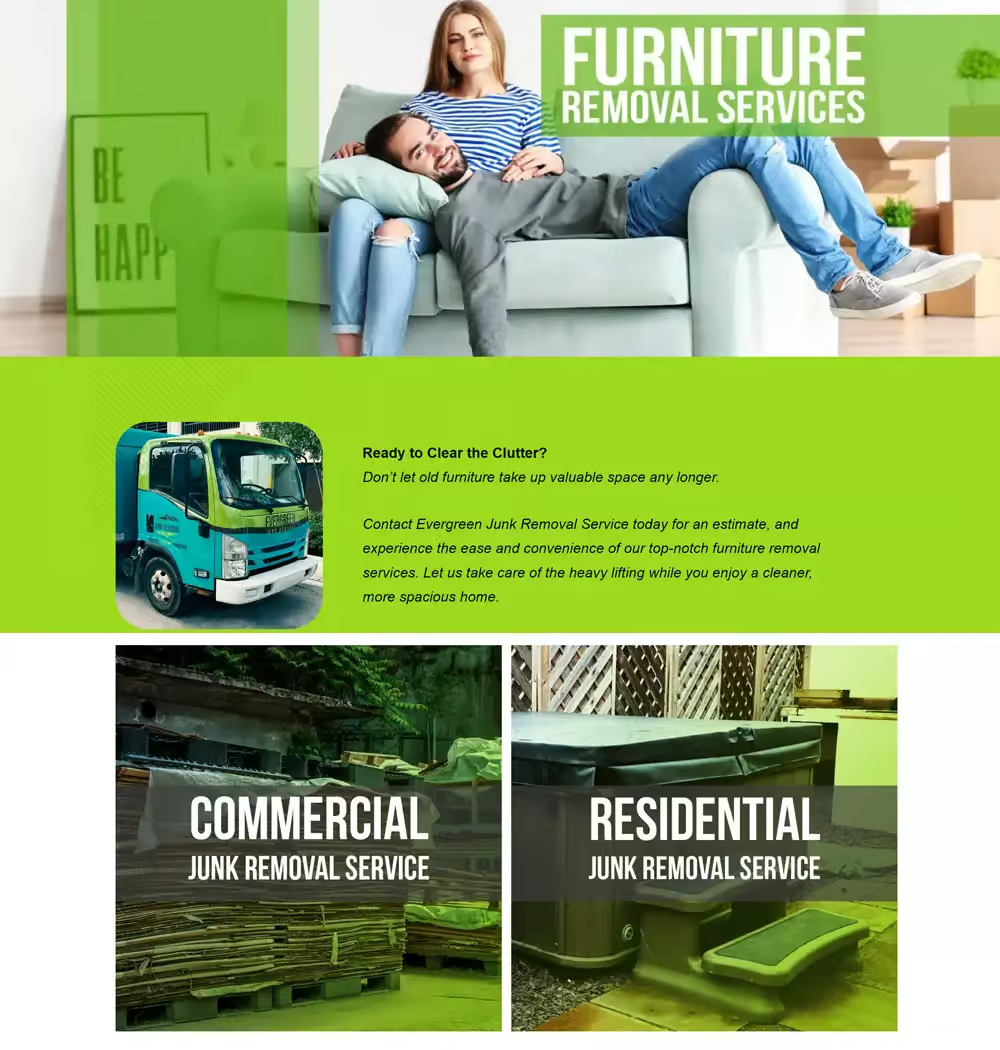
Paul owns Evergreen Junk Removal in South Florida. When he first contacted me around 2015, the business had no logo and almost no online presence.
I designed the logo and rebranded the website, then built out the visual system the business needed to be recognized locally: printed and digital flyers, social and advertising graphics, Pinterest and YouTube campaign visuals, webpage graphics, infographics, and truck decal wrap designs. I also worked on local SEO and site visibility.
Here is what I can document, with the caveat it deserves. Organic traffic went from roughly 1 to 3 daily visitors to around 60. The site reached the top 1 to 3 positions for multiple competitive local searches related to junk removal, boat removal, and similar services. During its stronger periods the business booked approximately $10,000 to $20,000 in monthly work and took roughly 20 to 30 calls a day.
Paul was also running paid advertising during that period. I do not claim the design and SEO work caused those numbers by itself. It was a meaningful contributing factor in a business that was doing several things at once, and honest attribution matters more to me than a bigger number on a service page.
The part I find most telling has nothing to do with analytics. Years later, clients in the Miami area recognized the trucks. The visual system had become part of the local landscape.
For a local service business, reviews and design carry the same load. BrightLocal's 2026 survey found 97% read reviews for local businesses, and 54% then visit the website before deciding. That is exactly the handoff Evergreen's site had to win: someone arrives already half-convinced, and the site either confirms it or loses it.

Your Website Is a Business Asset — Treat It Like One
A professionally built WordPress website is one of the most durable investments a business owner can make. Template solutions and self-build tools may look appealing upfront, but they tend to create real problems down the road:
- Generic designs that blend into the background and fail to earn trust
- Technical ceilings that limit what your site can do as your business scales
- Hidden costs in lost time, missed leads, and inevitable redesigns
When you hire a website designer for hire with real expertise, you are building something that works for your business every single day — not something you will have to redo in two years.
Each project gets a realistic, defined deadline agreed during scoping, before work begins. I set firm timelines deliberately, especially when a client already has an audience waiting. Projects without a schedule tend to drift, lose momentum, and become harder to finish.
Yes. I am based in Omaha, Nebraska, and work with clients nationally. Client work and delivery are handled digitally, through phone, text, Zoom, Google Meet, and screen sharing, whichever fits how you prefer to communicate.
Copywriting and content creation are available and factor into the project quote. If you are writing the content yourself, that is fine too, and I will tell you what each page needs before design starts so the layout is built around real content rather than placeholder text.
Then it stays. Blessed Hands CBD came to me with a logo the founder loved, and replacing it was never on the table. I recommend a fresh identity when the existing mark is genuinely holding the business back, not as a default upsell. You can see how I approach that decision on my brand identity page.
No, and that is by design. You purchase and own both, which keeps your key business assets under your control. If you are unsure what you need, I provide recommendations and walk you through the options.
No. I offer unlimited revisions and work toward a design outcome you are satisfied with.
Ready to Build a Website That Works as Hard as You Do?
Book a consultation call and let's talk about what your site actually needs to do.
On that call I listen first. Then I walk you through what I see: where the current site is falling short, which strategies fit your situation, and a clear picture of what the project would look like from brief to launch, including timeline and investment.
No pressure and no pitch deck. Just a direct conversation that leaves you with clarity on your next move, whether we end up working together or not.
Book Your Consultation Call
Let's talk about your vision for your brand. Use the calendar to book your free consultation call — you'll share your goals, get answers, and see whether we're the right fit for each other.