Your reputation earned you word of mouth. It won't get you chosen.
Watch what happens in the few seconds after someone hears your name, when you're not in the room.
TL;DR
- A referral doesn’t hand someone trust. It hands them curiosity, and they settle it by searching you before they ever call.
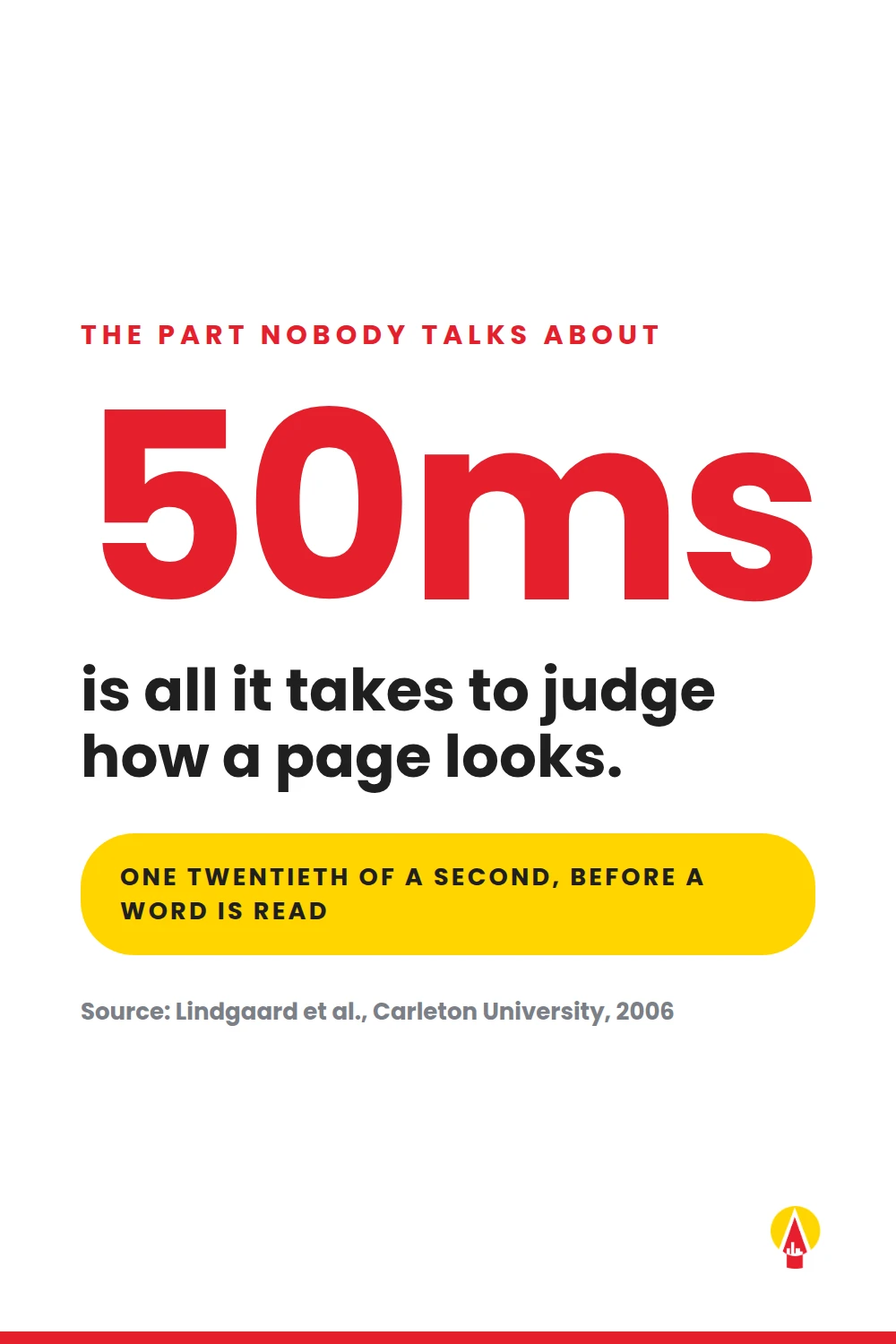
- People judge the visual appeal of a web page in about 50 milliseconds, so your first screen decides the referral before anyone reads what you do.
- Strangers build trust from agreement. Your logo, website, social page, and packaging have to say the same thing about what you sell and who it’s for.
- Word of mouth marketing works on the recommending side. The loss happens afterward, quietly, and nobody tells you.
- A free 10-minute check (three touchpoints, one rule) shows you where your handoff drops.
A colleague or family member mentioned your name to someone. That’s word of mouth marketing doing its job. But that person never called you, and nobody is going to tell you why.
You’re getting referrals, and they still aren’t turning into growth. Most business owners assume the referral does the selling. It doesn’t. Almost everything written about word of mouth marketing focuses on the person recommending you: their timing, their credibility, how well they know you. Very little of it covers what the stranger finds when they go looking.
I’ve spent 15 years designing brand identities. Here’s what decides those first few seconds after someone hears your name, and where most owners lose them.
What Happens After Someone Recommends Your Business?
They search you. The person who heard your name doesn’t walk to your door. They pull out a phone and type your business name, or they tap the link a friend texted them.
That step is almost universal. In a 2021 survey of 500 U.S. consumers, 76% of consumers said they look at a company’s online presence before visiting in person.
You’ve probably heard some version of this: “My friend’s going to reach out to you.” Then nothing. It’s easy to assume they got busy. More often, they looked, and something in what they found didn’t hold them.
Here’s a 30-second check. Open a private browser window, so your own browsing history isn’t shaping the results, and search your business name.
Whatever loads first is your referral experience. Not your website. That.
Is Word of Mouth Marketing Still Effective?
Yes. The recommending side of word of mouth is doing its job, and the data backs that up.
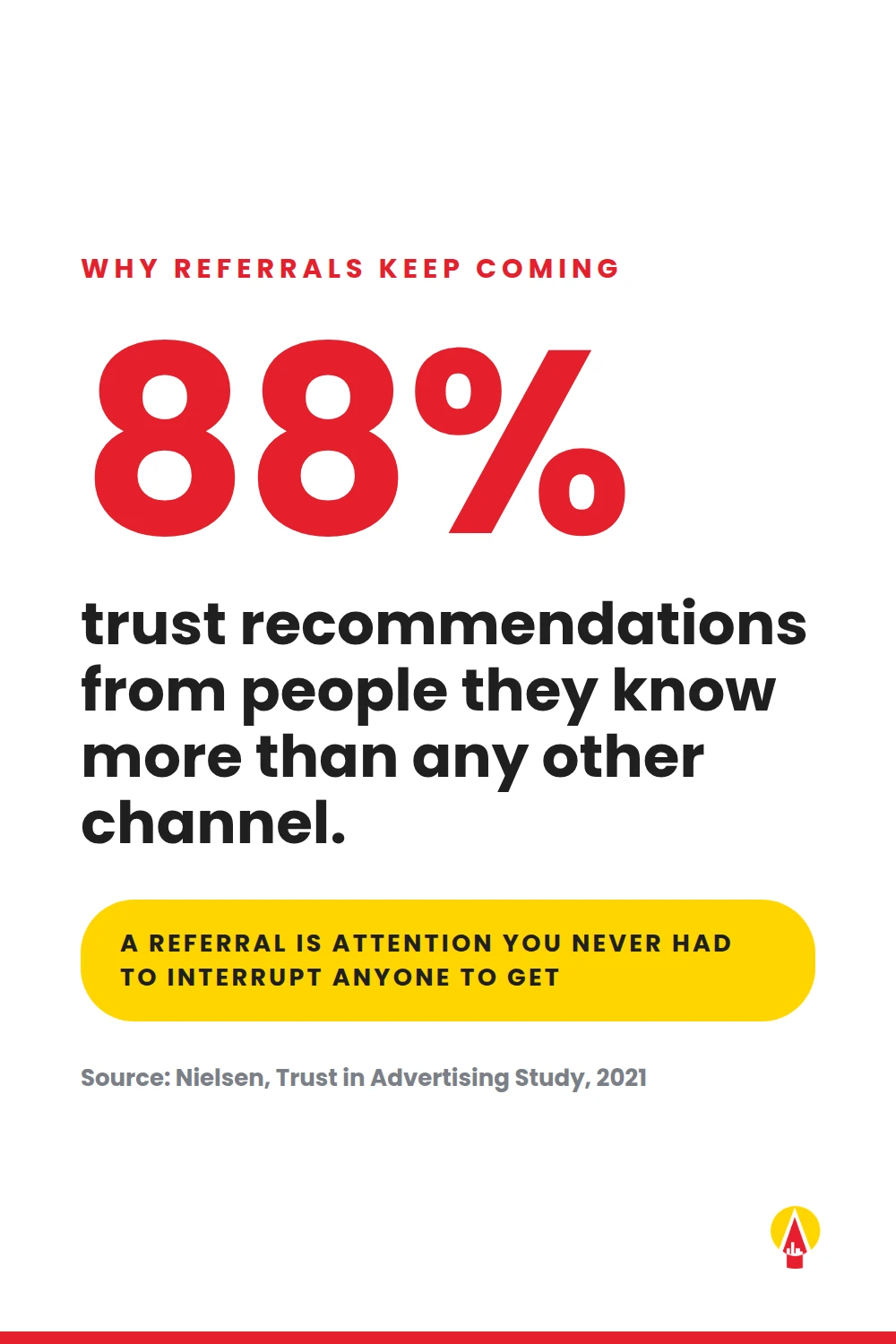
- Trust: In Nielsen’s 2021 study of more than 40,000 people worldwide, 88% of respondents said they trust recommendations from people they know more than any other channel.
- Influence: McKinsey found word of mouth shapes 20 to 50% of purchasing decisions, with the strongest effect on first-time and high-priced purchases.
- Value: A study in the Journal of Marketing found the average referred customer was worth at least 16% more than a comparable non-referred customer, with a higher retention rate that held over time.
Those word of mouth marketing statistics point to the same thing.
A referral is the one kind of attention you never had to interrupt anyone to get. Somebody went looking for you on purpose.
So the question isn’t whether word of mouth advertising works.
It’s whether the moment after it works. That’s where effectiveness actually gets decided, and it’s the part most owners never see.
How Fast Does a Stranger Judge Your Business?
About 50 milliseconds.
Researchers at Carleton University found that people form a judgment of a web page’s visual appeal in roughly one-twentieth of a second, and those snap ratings closely matched ratings made after longer viewing.
Think about what that means. Nothing has been read. Nothing has been compared.
The referral opened the door, and your first screen holds it open or closes it before anyone learns what you do.
It’s like getting directions to a store inside a mall. Your friend gets you most of the way there. But there’s no sign out front, so you walk right past it. Eventually you give up, and your friend never finds out.
This is why website design sits so close to word of mouth. Your site is often the storefront sign in that analogy.
When owners look for website designers, the conversation usually starts with features and page counts. It should start with the first screen a referred stranger sees, because that screen is judged before any feature gets a chance.

A Referral Hands People Curiosity, Not Trust
A clean search result still isn’t enough on its own, because a referral hands people something different from what most owners assume.
Here’s the distinction that matters. A referral doesn’t hand somebody trust. It hands them curiosity. Curiosity gets them to look. Trust is something they build themselves, in seconds, out of what they see.
What builds it fastest is agreement:
- Same mark
- Same colors
- Same type
- Same level of care, everywhere they find you
Most businesses don’t have that. You’ve probably got a logo somewhere, a page somewhere, maybe a label on a product. Line them up, and they could pass for three different businesses. Nobody makes this mistake on purpose. It happens one rushed decision at a time.
There’s a copywriting principle I keep coming back to. If a stranger can’t tell what you sell and who it’s for within a few seconds, the copy has failed. For your brand, that means every place people land has to answer those two questions the same way. When your logo design says one thing and your page says another, the stranger has to do extra work. Most won’t.
A 2019 Lucidpress survey of more than 200 organizations found that consistent branding can lift revenue by up to 33%. It’s self-reported, so treat it as a direction rather than a promise. But agreement is what a stranger reads as trust, and that part you control.
So try this. Open your website, your main social page, and a photo of your packaging or business card. Put them side by side and look at them together, not one at a time. If a stranger couldn’t tell they belong to the same business, your referral can’t either.
That’s the real job of a logo designer and of packaging design: not a single good-looking piece, but pieces that agree with each other wherever someone finds you.


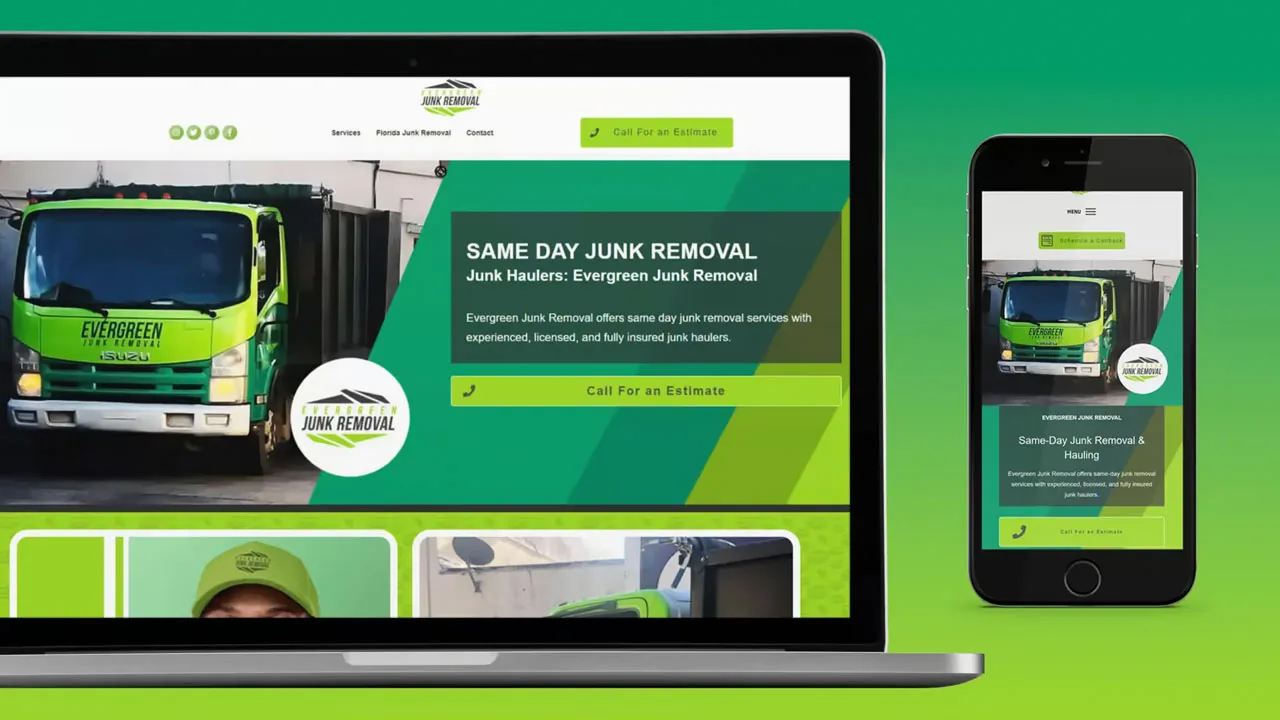
How Evergreen Junk Removal’s Trucks Got Ahead of the Introduction
There’s a belief that keeps owners from fixing any of this. Almost every owner has said some version of it: “My reputation speaks for itself.”
And it does. Right up until somebody has to find you.
In 2015, I started working with a South Florida business called Evergreen Junk Removal. The owner, Paul, didn’t come to me for branding design. He came for online marketing and SEO help, and he didn’t have a logo at all.
So he needed two things. People had to be able to find him, and they had to recognize him when they did.
I built the visual side from the ground up. The logo came first. Then the website, printed and digital flyers, social media and advertising graphics, infographics, and decal wraps for the trucks.
A truck wrap isn’t a campaign. It’s a surface. But it’s a surface that moves through the same neighborhoods where customers live.
Later on, clients of mine from the Miami area recognized those trucks. They knew the brand from the road before anyone introduced it to them.
Think about the last business you recommended without checking anything first. You had already seen it somewhere. That’s what recognition buys you. The visual system got out ahead of the introduction, so a referral didn’t have to carry all the weight anymore.
That’s the difference a brand designer for hire should be thinking about. A referral that gets caught doesn’t stop at one customer. That person becomes the next one who says your name. A dropped referral ends the chain, quietly.
How Do You Encourage Organic Customer Recommendations for a New Product Launch?
Give people something specific and consistent to repeat, and make sure it looks the same wherever they point others. Launch is when word of mouth carries the most weight, because McKinsey’s research shows it has the strongest influence on first-time purchases.
The same McKinsey work found that people tend to pass along functional messages more than emotional ones, such as the design of a phone or the ingredients in a skincare product. In skincare branding, that means the ingredient story and the label have to be clear enough for a customer to repeat accurately.
A few practical ways to support organic recommendations at launch:
- Decide the one sentence you want repeated. What you sell and who it’s for, in plain words.
- Put that sentence everywhere. Packaging, website hero, social bio, and product listings should all say it the same way.
- Give early customers something to share. Clean product images, a short link, and a label that photographs well.
- Make the first search result match the product. A referred buyer who finds a mismatched page may assume they have the wrong brand.
One launch that comes to mind is Deeper Than Roots, a Virginia haircare brand led by founder and CEO Angel. She came to me through a referral from a chemist after losing contact with a prior designer. The haircare branding needed a refined identity, product labels, and launch visuals. I refined the logo with a classic but edgy serif, replaced a literal side portrait with an abstract seed symbol surrounded by root-like forms, and created 3D product renders for pre-launch promotion and pre-orders. The brand launched at a convention with the updated identity, collateral, and product visuals in place.
For founders who need the full set of launch pieces to agree from day one, branding packages are built for exactly that job.
Can Excellent Customer Service Grow Word of Mouth?
Yes. Excellent service is usually what starts word of mouth, and poor service is what starts the negative kind.
Zendesk benchmark data shows that more than half of consumers switch after one bad interaction, while three in four will spend more with businesses that give a good experience. Bain’s Net Promoter research adds that promoters account for more than 80% of referrals in most businesses, and detractors account for more than 80% of negative word of mouth.
So service matters. But here’s the part owners miss. Being good at what you do is what starts word of mouth. It isn’t what finishes it.
A delighted customer can only send people to you. What those people find when they arrive is a separate problem, and great service can’t solve it after the fact.
Can Word of Mouth Marketing Be Integrated With Social Media Effectively?
Yes, and for many businesses social media is where the referral actually lands. When someone hears your name, your Instagram, Facebook, or LinkedIn page is often the first thing they open.
The 2023 Sprout Social Index found that 68% of consumers follow brands mainly to stay updated on products and services, and 51% said the most memorable thing a brand can do on social media is simply respond.
That points to two practical moves:
- Make the profile agree with everything else. Same mark, same colors, same one-sentence description of what you sell and who it’s for.
- Respond. A referred stranger who comments or messages you is halfway through the handoff. A quick, clear reply finishes it.
This matters even more in personal branding, where the owner is the business. If your personal page, your business page, and your website each present you differently, the referral has to guess which one is real.
What Tools Track Word of Mouth Marketing Campaigns?
The most useful tools are simple and mostly free: ask people where they heard about you, tag the links you hand out, and measure how likely customers are to recommend you.
Google Analytics uses UTM parameters such as source, medium, and campaign to show which links refer traffic. If you give customers a link to share, tag it. You’ll start to see referral traffic you couldn’t see before.
Net Promoter Score is built on one question: how likely a customer is to recommend the business to a friend or colleague, on a zero-to-ten scale. It won’t tell you why a referral dropped, but it tells you how many people are likely to send others your way.
The branded search check is the one most owners skip. It’s also the one that shows you the handoff directly.
Word of Mouth Isn’t Marketing. It’s a Handoff.
Here’s the ladder so far. The referral sends people to search. Your first screen gets judged before they read a word. Those pieces have to agree. And recognition can do part of that work before anyone says your name.
Which brings me to the thing I want to name for you.
Word of mouth isn’t marketing. It’s a handoff of partial information. And a handoff only counts if somebody catches it.
Your brand identity is the catch. Not the pitch. Not the reputation. Not the referral itself. It’s the few seconds in between, when you’re not in the room.
That’s how word of mouth ends up hurting a business while it looks like it’s working. It convinces you the job was done at the introduction, while every dropped handoff stays invisible. Nobody calls back, and nobody calls to tell you they decided not to choose you.
Here’s where I’ve landed on this. Word of mouth can carry a business for years. I don’t believe it carries one for good. If you’re not visually distinctive, people forget you. There’s a ceiling on how far referrals alone will take you, and most owners hit it without ever knowing what they hit.
The 10-Minute Handoff Check
This takes about 10 minutes, and it costs nothing.
- Pull up the three places a referral can land on you. Whatever comes up first when you search your business name in a private window, your main social page, and your packaging or business card.
- Apply one rule. All three have to say the same thing about what you sell and who it’s for.
- Find the one that disagrees. Whatever doesn’t match the other two is where your handoff drops.
- Fix the one that’s furthest off first. Usually it’s the one you put together in the biggest hurry.
Fix that one gap, and the next person who hears your name stops at your page instead of scrolling past it.
If you lined those three up and didn’t like what you saw, that gap is what I build for people: a brand identity that holds up in the few seconds you’re not in the room. Book a call with me to talk through where your handoff is dropping.
Genuine Branding Reviews From
Business Owners I've Helped
Time - 1:05 minutes
Time - 41 seconds
Time - 1:41 minutes
Time - 42 seconds
Let's talk about your vision for your brand. Use the calendar to book your free consultation call — you'll share your goals, get answers, and see whether we're the right fit for each other.